
You will Suffer . . . But Why?
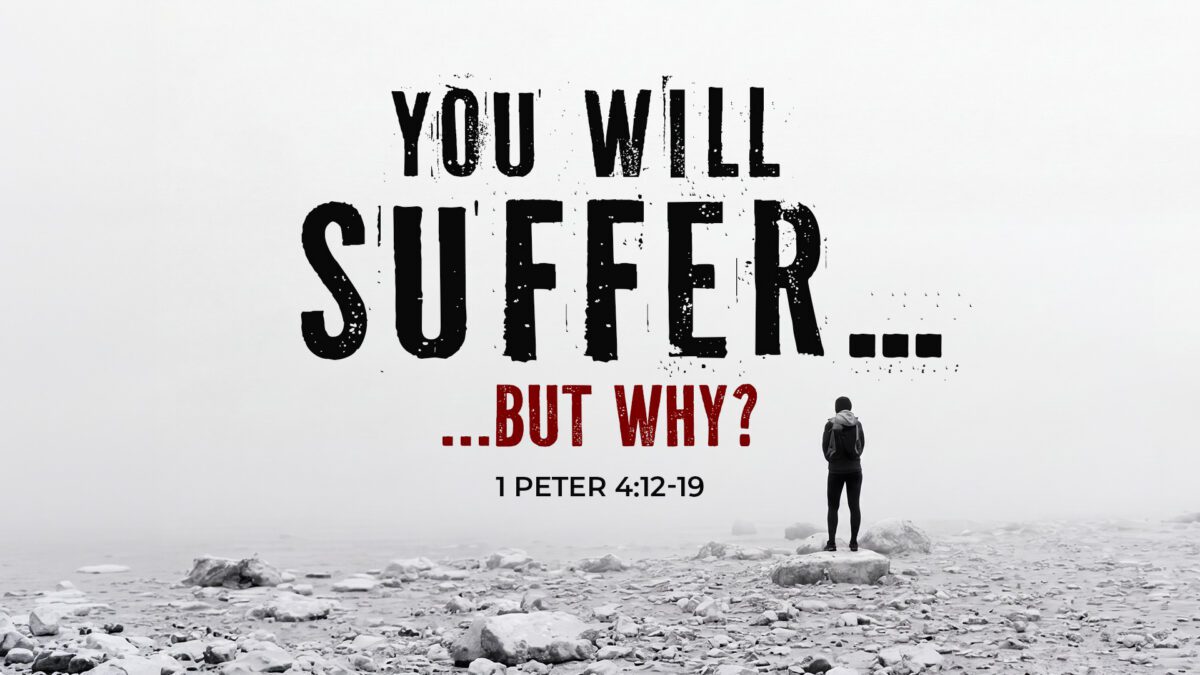
You Will Suffer . . . But Why?
Preached by Pastor Ford Pfister on September 27, 2026 | 1 Peter 4:12–19
1 Peter — “You Will Suffer . . . But Why?”
Beloved, do not be surprised at the fiery trial when it comes upon you to test you, as though something strange were happening to you. But rejoice insofar as you share Christ’s sufferings, that you may also rejoice and be glad when his glory is revealed. If you are insulted for the name of Christ, you are blessed, because the Spirit of glory and of God rests upon you. But let none of you suffer as a murderer or a thief or an evildoer or as a meddler. Yet if anyone suffers as a Christian, let him not be ashamed, but let him glorify God in that name. For it is time for judgment to begin at the household of God; and if it begins with us, what will be the outcome for those who do not obey the gospel of God? And “If the righteous is scarcely saved, what will become of the ungodly and the sinner?” Therefore let those who suffer according to God’s will entrust their souls to a faithful Creator while doing good. —1 Peter 4:12–19 (ESV)
One of my nephews, Cowen, is too curious and too smart for his own good. He’s definitely too curious and too smart for his Uncle Ford. And for some reason, when he asks life’s hardest questions, his mom tells him to call me.
In fourth or fifth grade, riding down the road, he noticed that churches had different words after their names. Some were Baptist, some Lutheran, some Methodist, some Assembly of God. So one Wednesday afternoon my phone rang, and he wanted to know why. I explained that some churches believe different things about the Bible. “Why? Don’t they read the same Bible?” I explained that some important passages are hard to understand, and well-intentioned followers of Jesus land in different places. “Why?” I told him the Spirit convicts us. “Well, if we have the same Spirit and the same Bible, why?” At that point I finally understood what it means to be a dad, because I got to say: “Just because.”
Maybe you’ve been through the why loop, where every answer you give earns another why that’s just as fair as the last. You can run almost anything through it. Why is the sky blue? Because of how sunlight interacts with the atmosphere. Why does it interact that way? Because the atmosphere scatters blue light more than other colors. Why? You can point to electromagnetic radiation. But why did God make light and matter work that way? Eventually I always land in the same place: “Honestly, I don’t know. That’s just how God made it.”
The why loop always proves two things. First, there’s a whole lot you can know. Second, there’s a whole lot you can’t know.
Children may have invented the why loop, but Christians have perfected it in our conversations with God. Why did God let this happen to me? Why isn’t He answering my prayer? Why did He let me fail? Why did He allow this relationship, or why didn’t He? Why do the wicked seem to prosper? Why would God let Christians be persecuted? We sing that it’s all “for His glory and my good,” and still we ask, why?
There’s a simple truth I love: Scripture is sufficient, not exhaustive. Scripture is sufficient: it gives us everything God intends us to have and everything we need to know Him, enjoy salvation, have faith and live in obedience. It answers a whole lot of life’s whys. But it isn’t exhaustive. It doesn’t tell us everything that could possibly be known. It tells us what God intended us to know. So eventually the why loop brings us to this admission: I was not created to be omniscient. I was created to be obedient.
As we continue in 1 Peter, the theme that keeps surfacing is suffering, and this passage opens with a hard truth. “Beloved” is Peter speaking to Christians, believers living as exiles. Don’t be surprised. Don’t think it strange when the fiery trial comes (1 Peter 4:12). Other translations call it “terrible trouble.” Peter is stating a simple, proven theological truth: you are going to experience evil and suffering. Count on it. It’s promised.
You will suffer . . . but why? I want us to brave the why loop only as far as Scripture allows, and I see at least three reasons.
You Will Suffer Because You Follow Christ
Most of the suffering in 1 Peter 4 is the kind that comes from following Jesus as Lord, Messiah and Savior. It’s suffering that comes as a consequence of doing good, not doing evil.
Look at verse 13: “rejoice insofar as you share Christ’s sufferings.” We’re not rejoicing in all suffering here. We rejoice insofar as our suffering is shared with Christ’s. Verse 14 makes it clearer: “If you are insulted for the name of Christ.” Verse 16 is clearer still: “if anyone suffers as a Christian.” Following Jesus is itself the cause.
Peter isn’t dropping new knowledge on us. He’s repeating what Jesus and Paul taught. Jesus reminded His disciples:
Remember the word that I said to you: ‘A servant is not greater than his master.’ If they persecuted me, they will also persecute you. If they kept my word, they will also keep yours. —John 15:20
Paul told the Philippians:
For it has been granted to you that for the sake of Christ you should not only believe in him but also suffer for his sake. —Philippians 1:29
And he told Timothy:
Indeed, all who desire to live a godly life in Christ Jesus will be persecuted. —2 Timothy 3:12
When I think about suffering for Christ, I think about Paul: stoned, beaten, imprisoned. Other apostles were even crucified like their Lord. I think of physical persecution. But suffering isn’t always physical, and most of what Peter describes is social. Everywhere he names what these exiles are facing, it’s social. They’re being falsely accused:
Keep your conduct among the Gentiles honorable, so that when they speak against you as evildoers, they may see your good deeds and glorify God on the day of visitation. —1 Peter 2:12
They’re being slandered, with false and damaging statements made about them:
Having a good conscience, so that, when you are slandered, those who revile your good behavior in Christ may be put to shame. —1 Peter 3:16
They’re being maligned, condemned and criticized:
With respect to this they are surprised when you do not join them in the same flood of debauchery, and they malign you. —1 Peter 4:4
And they’re being insulted for the name of Christ (1 Peter 4:14).
There’s a term I find fascinating: the social sanction. Émile Durkheim, a French sociologist who helped establish sociology as a discipline, described it as a society’s response to a person’s violation of its shared norms and expectations. “Social” means a group of people; “sanction” means a penalty. Durkheim argued that the most effective way to control people isn’t legislation or physical harm. It’s social pressure: approval for those who conform, and ridicule, shame, exclusion and alienation for those who don’t. His work laid much of the foundation for understanding how a society pressures individuals to abandon their convictions and conform.
You’ve experienced a social sanction whether you know it or not. If you’re a parent who’s been asked to buy Crocs or Sambas in the last two years, your kids were feeling one. When I moved from Argentina back to the Carolinas, I learned in third grade that I had a major life decision to make: Clemson or Carolina. My answer was that football is played with your feet. It’s in the name. Wrong answer, and devastating for a third grader’s social standing. Look at my middle school pictures and you’ll see I still didn’t care about football, but you’d better believe the hoodie I wore every day had a Clemson paw on it. I didn’t want the penalty, so I picked. Then I learned that if you pick Clemson, apparently you also have to hate South Carolina. As Pastor Chad pointed out, it’s our state school. It’s in the name! We all know what a social sanction looks like.
That’s what’s happening in 1 Peter. Christians, as they should, are breaking their society’s norms, and they’re being penalized for it. They aren’t being killed in large numbers. They’re being ostracized, alienated and cast out. That’s one kind of suffering we’re promised: people will speak against you, malign you, insult you and slander you because you don’t fit the mold.
If we aren’t experiencing this kind of suffering, one of two things must have happened. Either our culture has become so aligned with Christ that living out our convictions no longer breaks its norms (does that sound right?), or our conduct has become so similar to the culture’s that we don’t break its norms enough to warrant a sanction. So 1 Peter 4 confronts us with a convicting question: Are we living for Christ radically enough to earn social persecution, or are we living so much like our culture that we aren’t even considered a threat to its norms?
My family moved a lot, and I learned quickly that being a social chameleon is very safe. I’d adopt the culture, hobbies and interests of whatever school I landed in. My brother, Will, never cared much what society suggested. In middle school he attended a private school in the mountains, in an area where Christianity wasn’t normal, and he was labeled the “Jesus freak.” Guys tried to pick fights with him (I wouldn’t recommend it; he’s going to win), and when that didn’t work, they stole his things, threw them in the lake and slashed his tires. Even in elementary school, I remember thinking that if I were seen with him, I’d be penalized too. Will didn’t care in the slightest. For years I thought he was the problem between the two of us, because I could fit in with no trouble. All you have to do is compromise your convictions. He refused, because he cared more about obedience than about what people thought of him.
Here’s what I wish I could have told my brother when I was eight: when you suffer for following Christ, you have so much to rejoice in. Verse 12 teaches that the fiery trial refines you, so you come out closer to Jesus. Verse 13 teaches that you come to know Christ more intimately as you share in His sufferings. Verses 13 and 16 teach that your suffering brings glory to God. Verse 14 teaches that you are blessed. And verses 17–19 teach that your willingness to suffer for Christ affirms your salvation and secures your future.
You will suffer if you follow Christ. If you refuse to conform and live out your faith unapologetically, you will suffer. But you can rejoice in your coming reward.
You Will Suffer Because of Your Sin
The first kind of suffering comes from doing good. The second comes from doing evil, and it’s right there in verse 15. After commending those who share Christ’s sufferings, Peter breaks his own train of thought: “But let none of you suffer as a murderer or a thief or an evildoer or as a meddler” (1 Peter 4:15). Why would Peter interrupt a passage about suffering for doing good with a warning about suffering for doing evil?
I think we sometimes build a false paradigm in our minds: I can do good and suffer, or I can do evil and prosper. We imagine the choice is between following Christ and suffering, or conforming to the world and escaping it. Verse 15 teaches that the real choice is to suffer for Christ or to suffer for evil. It calls back to what Peter wrote just a page earlier:
For it is better to suffer for doing good, if that should be God’s will, than for doing evil. —1 Peter 3:17
The implication is grim: evil results in suffering too. Because we live in a fallen and deeply broken world, suffering comes from doing good as we follow Christ, and it comes from doing evil as we disobey Him. We may think people who pursue evil seem to prosper, but Peter reminds us that isn’t the case.
When you suffer for doing good, you can cling to the promises of this passage: refinement, knowing Christ, blessing, God’s glory and a secure future. But those promises aren’t given to suffering that comes from evil. I think we sometimes cling to promises meant for those suffering for righteousness while we’re really suffering the consequences of our sin.
King David is a clear example. In the world’s eyes he could do whatever he wanted. He gave in to temptation and committed adultery, and he stayed king. He kept his wealth, his status and his power. But listen to how he describes that season:
For when I kept silent, my bones wasted away through my groaning all day long. For day and night your hand was heavy upon me; my strength was dried up as by the heat of summer. —Psalm 32:3–4
That’s the pain and turmoil of choosing evil. David isn’t sharing in Christ’s sufferings. He isn’t glorifying God or being blessed through his adultery. He’s simply feeling the weight of his sin.
Yet even here there’s something to rejoice in: forgiveness. David goes on:
I acknowledged my sin to you, and I did not cover my iniquity; I said, “I will confess my transgressions to the LORD,” and you forgave the iniquity of my sin. —Psalm 32:5
John makes the same promise:
If we confess our sins, he is faithful and just to forgive us our sins and to cleanse us from all unrighteousness. —1 John 1:9
And Paul tells us:
There is therefore now no condemnation for those who are in Christ Jesus. —Romans 8:1
When we suffer because we follow Christ, we rejoice in our reward. When we suffer because of our sin, we rejoice in forgiveness.
You Will Suffer Because of Corruption
There’s a third reason we suffer that I believe has to be included. It doesn’t come directly from this passage, but it’s essential to answering the question. Peter has addressed suffering as a consequence of good and suffering as a consequence of evil. I don’t think the application is to take everything painful you’ve experienced and sort it into one of those two boxes, because there’s a third: suffering as a consequence of the fall.
The moment sin entered the garden, God’s perfect creation was corrupted, and it’s been broken and marred ever since. My favorite definition of evil from our Wednesday night study asks: What if evil isn’t a thing, but the corruption of a good thing? Because of the fall, no part of creation is untouched by corruption. So some suffering isn’t caused by anyone’s choice to do good or bad: a devastating diagnosis, an unexpected loss, a season of hardship, a relationship that falls apart, a situation too deep to understand, a hardship no one saw coming. Christian apologetics has a term for this: surd evil (S-U-R-D), evil that is unexplained, irrational or without an apparent reason. It’s simply the result of the fall.
I don’t want anyone going home thinking the suffering in their life must be the direct result of some past sin. There’s a third category, and it comes with its own promise. If you’re suffering because of corruption, you can rejoice in restoration. Through Isaiah, God says:
For behold, I create new heavens and a new earth, and the former things shall not be remembered or come into mind. —Isaiah 65:17
And Paul writes that creation is waiting for the day:
that the creation itself will be set free from its bondage to corruption and obtain the freedom of the glory of the children of God. —Romans 8:21
Corruption as we know it will end. There will be no more tears and no more suffering (Revelation 21:4), and God will make right everything we’ve made wrong.
The Things Revealed Belong to Us
At the start I said the why loop always proves two things. First, there’s a lot we can know. We can know why we suffer: because of good, because of evil and, as the rest of God’s Word shows us, because of corruption. And we can know what to rejoice in for each: our reward, our forgiveness and God’s restoration.
Second, there’s a lot we can’t know. I can’t tell you why a specific thing did or didn’t happen in your life. I know God can work it for good. I know we can rejoice in reward, forgiveness and restoration. But I don’t know why, and it would be wrong for me to pretend I do. I’ve always loved how Moses puts it:
The secret things belong to the LORD our God, but the things that are revealed belong to us and to our children forever, that we may do all the words of this law. —Deuteronomy 29:29
I won’t pretend to have every answer. But I’ve been given enough truth to know that my role isn’t exhaustive knowledge. It’s humble obedience based on sufficient truth.
So let me ask you:
Are you suffering because you follow Jesus? Rejoice in your reward: God is glorified, you are blessed, you are being refined, you are coming to know Christ more intimately and your future is secure. If you aren’t suffering this way, it doesn’t necessarily mean you’re doing something wrong. But it does raise the question: Am I living for Christ so radically that it demands culture’s pushback? Don’t let a social sanction control your conduct. Let the Word of God alone do that.
Are you suffering because you’re living in sin? It’s better to suffer for doing good than for doing evil. If there’s an area where you’re choosing disobedience, God doesn’t leave you without a promise. Confess it, turn from it and rejoice in forgiveness.
Are you suffering because of the corruption of this world? First, I’m so sorry for the pain that brokenness causes. Cling to the promise that it will not stay this way. A day is coming when every tear will be wiped away, every broken thing will be restored and corruption will be defeated forever.
We don’t know it all. But whatever the cause of our suffering, we know enough to love God, to trust Him and to worship Him.
Scripture references in this message: 1 Peter 4:12–19; John 15:20; Philippians 1:29; 2 Timothy 3:12; 1 Peter 2:12; 1 Peter 3:16; 1 Peter 4:4; 1 Peter 3:17; Psalm 32:3–5; 1 John 1:9; Romans 8:1; Isaiah 65:17; Romans 8:21; Revelation 21:4; Deuteronomy 29:29. (ESV)
Want to go deeper? Gather your small group with this week’s discussion guide, and join us Sunday as we continue our study of 1 Peter at Berea First Baptist Church.
Scripture quotations are from the ESV® Bible (The Holy Bible, English Standard Version®), copyright © 2001 by Crossway, a publishing ministry of Good News Publishers. Used by permission. All rights reserved.