
Living with the End in Mind
Living with the End in Mind
Preached by Pastor Ford Pfister on July 5, 2026 [watch online] | 1 Peter 1:13–21 (ESV)
1 Peter — “Living with the End in Mind”
13 Therefore, preparing your minds for action, and being sober-minded, set your hope fully on the grace that will be brought to you at the revelation of Jesus Christ. 14 As obedient children, do not be conformed to the passions of your former ignorance, 15 but as he who called you is holy, you also be holy in all your conduct, 16 since it is written, “You shall be holy, for I am holy.” 17 And if you call on him as Father who judges impartially according to each one’s deeds, conduct yourselves with fear throughout the time of your exile, 18 knowing that you were ransomed from the futile ways inherited from your forefathers, not with perishable things such as silver or gold, 19 but with the precious blood of Christ, like that of a lamb without blemish or spot. 20 He was foreknown before the foundation of the world but was made manifest in the last times for the sake of you 21 who through him are believers in God, who raised him from the dead and gave him glory, so that your faith and hope are in God. —1 Peter 1:13–21 (ESV)
My brother Will is an ultra-marathon runner. An ultra-marathon pushes far past the 26 miles of a normal marathon; most recently Will ran 66 miles through remote mountain trails in North Carolina. The first time Pastor Chad met him, Will had just finished a 44-mile run in preparation. Chad looked at Will, fresh off the trail, then looked at me, fresh out from behind my desk, and asked, “What happened to you?” I’ve thought about that question ever since.
I could never run an ultra-marathon. For starters, I’m in terrible shape. But the bigger problem is my mentality. Will’s superpower is his mind. The first marathon he ever ran, he didn’t train for. He signed up that morning, got up, told himself, “I will run to the finish line and I won’t stop,” and then ran the whole way without stopping. He’s a machine. I am a human. When I run, I think: this hill is steep, my feet hurt, and I own a car for crying out loud.
Will’s strategy is simple. He thinks about the end, and he doesn’t stop until it’s over. My strategy is just as simple, and far less useful: I think about the pain in the moment, and it makes me stop. God’s word constantly compares the Christian life to running a race. We are running to win (1 Corinthians 9:24–27). We’re warned not to run in vain (Galatians 2:2; Philippians 2:16) and to run responsibly (Galatians 5:7). We’re told to forget what’s behind and press on toward the goal (Philippians 3:12–14), that finishing will take endurance (Hebrews 12:1–3), and Paul closes his own life with, “I have fought the good fight, I have finished the race, I have kept the faith” (2 Timothy 4:7–8).
So the question is which strategy we’ll run with: Will’s, fixing our eyes on the end and enduring, or mine, fixing our eyes on the pain of the moment and losing sight of what matters. As Christians, we have to live with the end in mind. That is exactly what Peter is teaching us in 1 Peter 1:13–21.
Before we get into verse 13, let me catch you up. First Peter is a letter written by Peter the apostle to Christians scattered across Asia Minor, roughly modern-day Turkey. These believers had experienced social rejection, economic hardship, and in the most extreme cases physical persecution, all because they followed Jesus. Peter’s message to them is honest: life is hard and full of suffering, but there are a few things you have to remember as you endure it.
The first twelve verses of chapter one are all about remembering your salvation. Peter reminds them that they were chosen by God (v.1), that Christ died for them (v.2), that they’ve been born again because Jesus rose again (v.3), that they have an imperishable inheritance waiting in heaven (v.4), and that God’s own power is guarding that salvation so it can’t be stripped away (v.5). Then he tells them their salvation is so magnificent that even angels long to look into it (vv.10–12). Peter fixes their eyes on what Christ has done, and then, with that still in mind, he pivots (1 Peter 1:1–12).
That pivot is the word “therefore” in verse 13. Verses 1 through 12 are about thinking about our salvation; verses 13 through 21 are about living in light of it. Because you have been saved by God and purchased at the price of Jesus’ life, Peter says, here is how you now live.
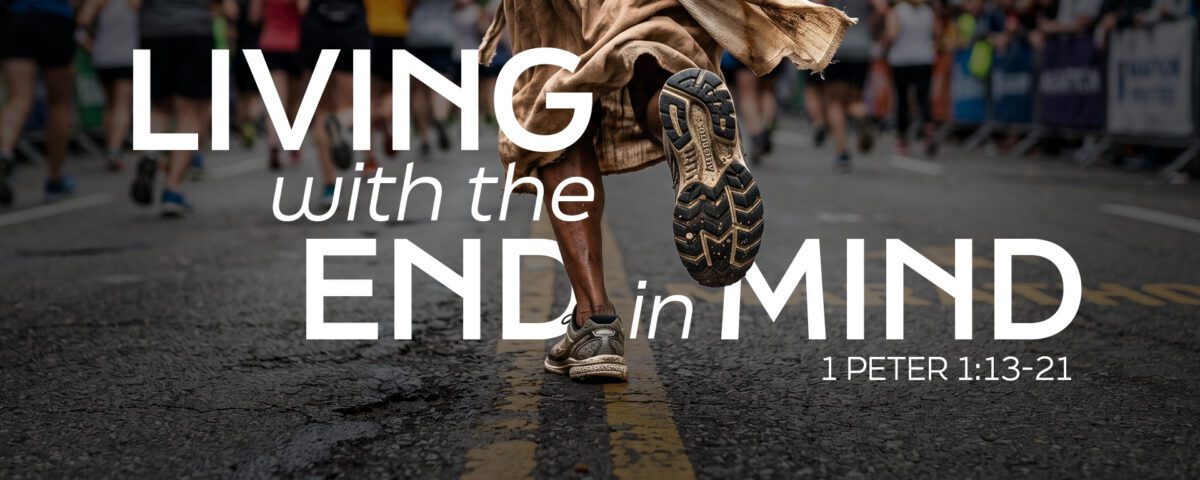
Verse 13 has three parts. First, “preparing your minds for action.” That phrase is an old idiom, translated more literally in the King James as “gird up the loins of your mind.” Peter and the apostles wore robes, not rolled-up running shorts. To gird up your loins meant to grab the hem of your robe, pull it up, and tie it off so you could actually move. I learned how necessary that is when Kari Garzon cast me as Joseph in the children’s musical last year. The robe was not tailored to me, and Joseph was supposed to pop up all over the auditorium. It turns out you cannot run in a robe; the penguin shuffle does not do stairs. So I swallowed my pride, picked up the hem, and jogged. That is Peter’s picture: pick up anything that slows you down and get ready to run. Get ready for battle. This is not going to be easy.
Second, “being sober-minded.” This isn’t a stray comment about avoiding alcohol. Peter is telling us to be level-headed, clear, calm, and fully aware of what’s ahead. He is being honest that the Christian life can be treacherous, and he wants us to see it clearly, with no rose-tinted glasses.
Third, and most important, “set your hope fully on the grace that will be brought to you at the revelation of Jesus Christ.” Here the word “hope” can trip us up, because it means something different in English than it does in Greek or Hebrew. In English, hope implies doubt. “I hope it doesn’t rain” leaves room for rain. “I hope Argentina wins the World Cup,” but France looks strong this year. “I hope Rebecca agrees to lunch at the Big Clock of Berea,” but we may already have plans. In Greek and Hebrew, hope implies confidence and trust. Peter isn’t telling us to cross our fingers and hope Jesus comes back. He’s telling us to bank everything on the guaranteed promise that Jesus will return for His children, like a groom coming back for his bride to carry her home.
This marathon of life is full of twists and turns. If you’ve lived more than a day or two, you know it: joy and heartbreak, celebration and mourning, health and sudden illness, peace and conflict, laughter and tears, success and failure, loyalty and betrayal, comfort and suffering. This is why Will is such a good runner. Nothing bad takes his eyes off the end, and nothing good does either. If it’s steep, he runs up the hill. If there’s a river, he runs through it. He also doesn’t stop for the views, the shade, or a comfortable food break; he grabs the snack and keeps running.
Both the valleys and the mountaintops can pull our eyes off the finish line. Suffering can convince us there’s no light at the end of the tunnel, and comfort can convince us the light this world offers is better than the light waiting at the end. For someone here, the return of Jesus and an eternity with Him is meant to be the light at the end of the tunnel of your suffering. For someone else, that same return is meant to outshine the comforts that have quietly distracted you. Either way, this earth is just a bus stop on the road to heaven. Some of us have decided the bus stop is more enjoyable than the destination; others are so broken down at the bus stop that they’ve stopped thinking about the destination at all.
And the world is passing away along with its desires. —1 John 2:17a (ESV)
17 For this light momentary affliction is preparing for us an eternal weight of glory beyond all comparison, 18 as we look not to the things that are seen but to the things that are unseen. For the things that are seen are transient, but the things that are unseen are eternal. —2 Corinthians 4:17–18 (ESV)
What God is calling us to here is to pick up our robe, clear our heads, stay fully aware of the suffering and the circumstances we face, and still choose to fix our eyes and live with the end in mind. Then, in verses 14 through 21, Peter gives us three reminders that help us do exactly that.
Holy Conduct
If you want to run with the end in mind, the first thing to prioritize is holy conduct.
14 As obedient children, do not be conformed to the passions of your former ignorance, 15 but as he who called you is holy, you also be holy in all your conduct, 16 since it is written, “You shall be holy, for I am holy.” —1 Peter 1:14–16 (ESV)
Peter says we cannot go back to being “conformed to the passions of our former ignorance.” We can’t return to the way we lived before we met Jesus, because everything has changed. Instead we’re to be holy in all our conduct, because the One who called us is holy. The best translation of that word “holy” is the idea of being set apart. You might remember our DNow theme from two years ago, “Set Apart.” Will Snipes taught it to our students and Kaylyn Watson taught it to our children.
When we think about being set apart, we usually reach for a few attributes: be loving in a world that isn’t loving, kind in a world that isn’t kind, forgiving in a world that isn’t forgiving. None of that is wrong, but it’s incomplete. We are not called to manufacture a few behaviors. We are called to be fundamentally different. Think about who you were before Christ. For me, the answer was never going to be occasionally showing a little more kindness or being slightly more patient with my little sister. I couldn’t just modify my behavior. That’s why Jesus talks about being born again. My pride corrupts even my good deeds, so I don’t need a tune-up; I need to become someone new.
Beloved, I urge you as sojourners and exiles to abstain from the passions of the flesh, which wage war against your soul. —1 Peter 2:11 (ESV)
Seven different English translations swap “sojourners” for “aliens.” The point is that Christians aren’t meant to look like the world with slightly adjusted behavior. We’re meant to look fundamentally different, as different as someone in a bright green morph suit walking down the hall. (We’ll spare you the morph suit this morning and stick with the pocket-sized alien.) There are many true adjectives for God: loving, gracious, merciful, faithful, mighty, righteous, just, sovereign, good, wise, almighty, compassionate, patient. But only one is chanted three times in a row around His throne.
And one called to another and said: “Holy, holy, holy is the LORD of hosts; the whole earth is full of his glory!” —Isaiah 6:3 (ESV)
…and day and night they never cease to say, “Holy, holy, holy, is the Lord God Almighty, who was and is and is to come!” —Revelation 4:8 (ESV)
In the Old Testament and again in the New, the angels chant, “Holy, holy, holy.” As believers living with the end in mind, our lives should be chanting that same word to the people around us. That’s a far higher bar than occasional acts of kindness; it’s total transformation. So here’s the question worth sitting with: what word does your life chant?
Holy Judge
The second way to live with the end in mind is to remember that there is a holy Judge.
And if you call on him as Father who judges impartially according to each one’s deeds, conduct yourselves with fear throughout the time of your exile. —1 Peter 1:17 (ESV)
Peter holds two things together here. God is our loving Father, the One we call on and cry out to. He is also our righteous Judge, who judges impartially according to each person’s deeds. Father and Judge, at the same time. I’ll never forget the first time I visited my mom’s third-grade classroom. At home she nurtured me; Rebecca would say she spoiled me. She cooked three separate dinners because my brother was vegan and my sister was vegetarian. She packed my lunches long after that was normal, and we used to grade our moms’ love by how well our lunches were packed. Two PB&Js and a note on the napkin, and I won every time. Then I heard the tone she used in that classroom, and I thought she might do something violent. Loving mom, righteous teacher. As a kid I couldn’t reconcile the two, so I decided I didn’t have to; at home she’d just be loving mom.
With God we don’t get to split Him like that. We have to hold His attributes together. We can make the mistake of camping out on His love and neglecting His righteousness, which slides into tolerance of sin, compromise of biblical truth, and even trying to take advantage of His mercy, the very thing Paul rejects when he asks whether we were saved so we could keep on sinning. Or we can camp out on His justice and neglect His love, which curdles into legalism, self-righteousness, joyless religion, and a fear-based obedience that treats Him as a tyrant upstairs. So how do you balance a righteous Judge and a loving Father? The secret is one word: reverence. Reverence is a profound and deep respect, love, and awe.
Then he said, “Do not come near; take your sandals off your feet, for the place on which you are standing is holy ground.” —Exodus 3:5 (ESV)
But when Simon Peter saw it, he fell down at Jesus’ knees, saying, “Depart from me, for I am a sinful man, O Lord.” —Luke 5:8 (ESV)
When I saw him, I fell at his feet as though dead. But he laid his right hand on me, saying, “Fear not, I am the first and the last.” —Revelation 1:17 (ESV)
Reverence looks like Moses removing his sandals, Peter falling at Jesus’ knees and calling himself a sinful man, and John falling down as though dead before the glorified Christ. As children of God we never have to fear being cast out by our loving Father, but we do keep a healthy reverence for our righteous Judge. So who is God to you? Only a judge? Only a loving father? Your answer will shape your whole relationship with Him. The balance I’m after is a hatred for sin that matches God’s, held together with a love for His grace that matches the love of a father.
Holy Sacrifice
Finally, and most importantly, to live with the end in mind you have to remember that your life was purchased with a holy sacrifice.
18 knowing that you were ransomed from the futile ways inherited from your forefathers, not with perishable things such as silver or gold, 19 but with the precious blood of Christ, like that of a lamb without blemish or spot. 20 He was foreknown before the foundation of the world but was made manifest in the last times for the sake of you 21 who through him are believers in God, who raised him from the dead and gave him glory, so that your faith and hope are in God. —1 Peter 1:18–21 (ESV)
How can you and I stand before a holy Judge and be counted holy? Only because a holy sacrifice took place. To be ransomed is to have your release secured, your freedom purchased, and Peter is clear that our freedom wasn’t bought with perishable things like silver or gold. It was bought with the precious blood of Christ, the Lamb without blemish or spot. Verse 20 tells us this was no accident: Jesus was foreknown before the foundation of the world. God knew from the very beginning that His plan was to purchase your life with His only Son, and He chose it. Look at the last words of verse 20: “for the sake of you.” Why would God watch His Son be killed, buried, and raised again? Verse 21 answers it: so that your faith and hope are in God, and not in this world.
Living with the End in Mind
To really understand living with the end in mind, it helps to walk the points backward. If I want to run toward heaven, I start by understanding that a holy sacrifice died in my place. That sacrifice came from a holy Judge, who gave up His own Son so He could remain just in His judgment on sin and still be a loving Father to sinners. And once I’ve seen that a holy Judge would sacrifice His holy Son for my sake and then call me to “be holy, for I am holy,” the only fitting response with my life is holy conduct.
I’m glad our Fuge staff are here this morning. Nobody does that work for the money; by our math one summer it came out to around two dollars an hour, and it isn’t exactly a résumé builder either. They don’t do it for the money, the credit, or the accolades. They do it because they know their lives were purchased with a holy sacrifice, in front of a holy Judge, who has called them to run their race with the end in mind: the salvation of children and students across the country, for God’s glory and not their own.
So the question Peter leaves with all of us is simple. Are you living with the end in mind? Maybe you’ve gotten caught up in the comforts of this world and forgotten that this is only a bus stop. Or maybe your race has taken hard turns, like the believers Peter first wrote to, and the suffering is real. If you’re in the first group, let the holy sacrifice of a holy Judge call you back to living with the end in mind. If you’re in the second, let the glorious light of the return of Jesus Christ be the fuel that keeps you running.
Scripture references in this message: 1 Corinthians 9:24–27; Galatians 2:2; Galatians 5:7; Philippians 2:16; Philippians 3:12–14; Hebrews 12:1–3; 2 Timothy 4:7–8; 1 Peter 1:1–12; 1 Peter 1:13; 1 John 2:17; 2 Corinthians 4:17–18; 1 Peter 1:14–16; 1 Peter 2:11; Isaiah 6:3; Revelation 4:8; 1 Peter 1:17; Exodus 3:5; Luke 5:8; Revelation 1:17; 1 Peter 1:18–21. (ESV)
Want to go deeper? Join us for worship on Sundays at Berea First Baptist Church.
Scripture quotations are from the ESV® Bible (The Holy Bible, English Standard Version®), copyright © 2001 by Crossway, a publishing ministry of Good News Publishers. Used by permission. All rights reserved.